
Minor in Poverty, Inequality, and Social Justice
The minor teaches students to analyze the structural and political causes of poverty and intersectional inequality, and their effects on people and communities. Students take History 74, three upper-division electives from departments outside their major, a 120-hour internship with a community organization, and a capstone seminar. The Department of History and the Blum Center offer the minor together.
Forms
- Minor requirements (2025)Every required course and course option
- Minor checklistA step-by-step record of your progress
- Pre-approved course substitutions (Summer 2025)Upper-division courses already approved for the minor
- Internship learning agreementSign and return it to Dr. Partridge, who directs the internship program, to receive an add code for HIST 196SJ or GLOBL 196SJ
- Student FAQ (May 2024)Answers to common questions
- Course petitionsHow to count a course that is not on the requirements sheet
Required courses
- HIST 74Offered in Fall and Summer only. No other course can substitute for it.
- HIST 196SJ or GLOBL 196SJ, the internshipOffered in Fall, Winter, and Spring, to students declared in the minor. Contact Dr. Partridge, who directs the internship program, 8 to 10 weeks before you plan to enroll.
- HIST 174Q or GLOBL 193, the capstone seminarOffered in Winter and Spring, and in Summer when enrollment allows. Requires the internship first; you cannot take both in the same quarter.
- Three upper-division electivesAll three must come from departments outside your major. See the requirements sheet and the substitutions list.
Course sequence
- Take HIST 74 and one upper-division elective. You must have completed both, or be enrolled in both, when you apply.
- Apply to the minor. Current UCSB students apply during Winter Quarter. Transfer students should check the application page for their dates.
- Arrange your internship. Contact the Blum Center 8 to 10 weeks before you enroll in HIST 196SJ or GLOBL 196SJ.
- Take the capstone seminar. Enroll in HIST 174Q or GLOBL 193 after you complete the internship.
Complete your other two upper-division electives at any point along the way. See course options for examples.
Checking your declaration in GOLD
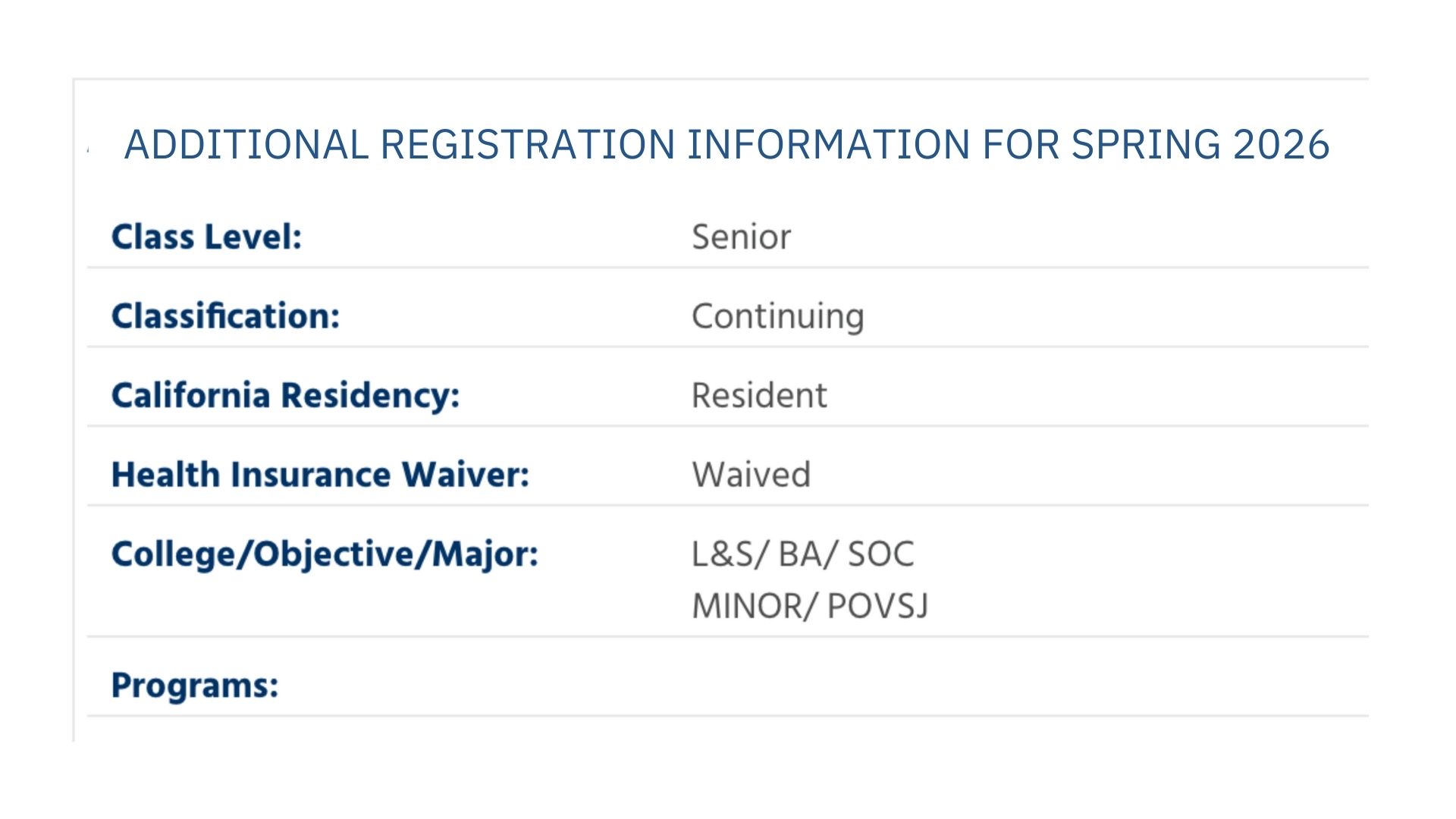
To confirm you are declared in the minor, log into GOLD, open the yellow Registration tab, and look in the Additional Registration Information box at the bottom left. Declared students see MINOR/POVSJ, the minor's code in the university's records.
For more on the internship, the capstone seminar, and elective options, see the internship program, capstone seminar, and course options pages.
HIST 74
History 74: Poverty, Inequality, and Social Justice in Historical and Global Context
The course takes historical and interdisciplinary perspectives on poverty and inequality, globally and in the United States. It traces structural transformations; shifting modes of thought, policy, and action; dynamics of class, racial, gender, ethnic, and geographic stratification; and major theoretical debates from antiquity to the present.
Offered in Fall and Summer only. You must have completed HIST 74, or be enrolled in it, along with one upper-division elective, when you apply to the minor.
Upper-division electives
All three electives must come from departments outside your major. A Biology major takes them outside Biology, a History major outside History, and so on. You may count no more than 5 upper-division units toward both your major and the minor, or toward two minors.
You can meet the elective requirement three ways:
- Courses listed on the minor requirements sheet.
- Courses on the pre-approved substitutions list, which require a short petition.
- Another course that addresses poverty, inequality, or social justice, approved by petition to the Undergraduate Advisor in the Department of History.
A course not on the pre-approved list
Before you petition, make sure that:
- The course addresses poverty, inequality, or social justice.
- You have the syllabus. Ask the instructor if you need a copy.
- A letter grade for the course is posted in GOLD. Courses taken Pass/No Pass cannot be petitioned.
Then the Undergraduate Advisor in the Department of History, at history-undergraduate-advisor@ucsb.edu, with your name, perm number, the course number, and the syllabus.
A course not on the pre-approved list
Before you petition, make sure that:
- The course addresses poverty, inequality, or social justice.
- You have the syllabus. Ask the instructor if you need a copy.
- A letter grade for the course is posted in GOLD. Courses taken Pass/No Pass cannot be petitioned.
Then email the Undergraduate Advisor in the Department of History at history-undergraduate-advisor@ucsb.edu, with your name, perm number, the course number, and the syllabus.
A course on the pre-approved list
The substitutions list names upper-division courses already approved for the minor. The course must come from outside your major department, and its grade must be posted in GOLD before you petition.
Email the Undergraduate Advisor in the Department of History, at history-undergraduate-advisor@ucsb.edu, with your name, perm number, and the course number.